


Thinking Like a Synthesiser
By Barry F. Dowling (Author)
Have you ever opened a synthesiser and wondered what all those knobs, sliders, waveforms and mysterious controls actually do?
What if you could look at almost any synthesiser and understand what it is trying to tell you?
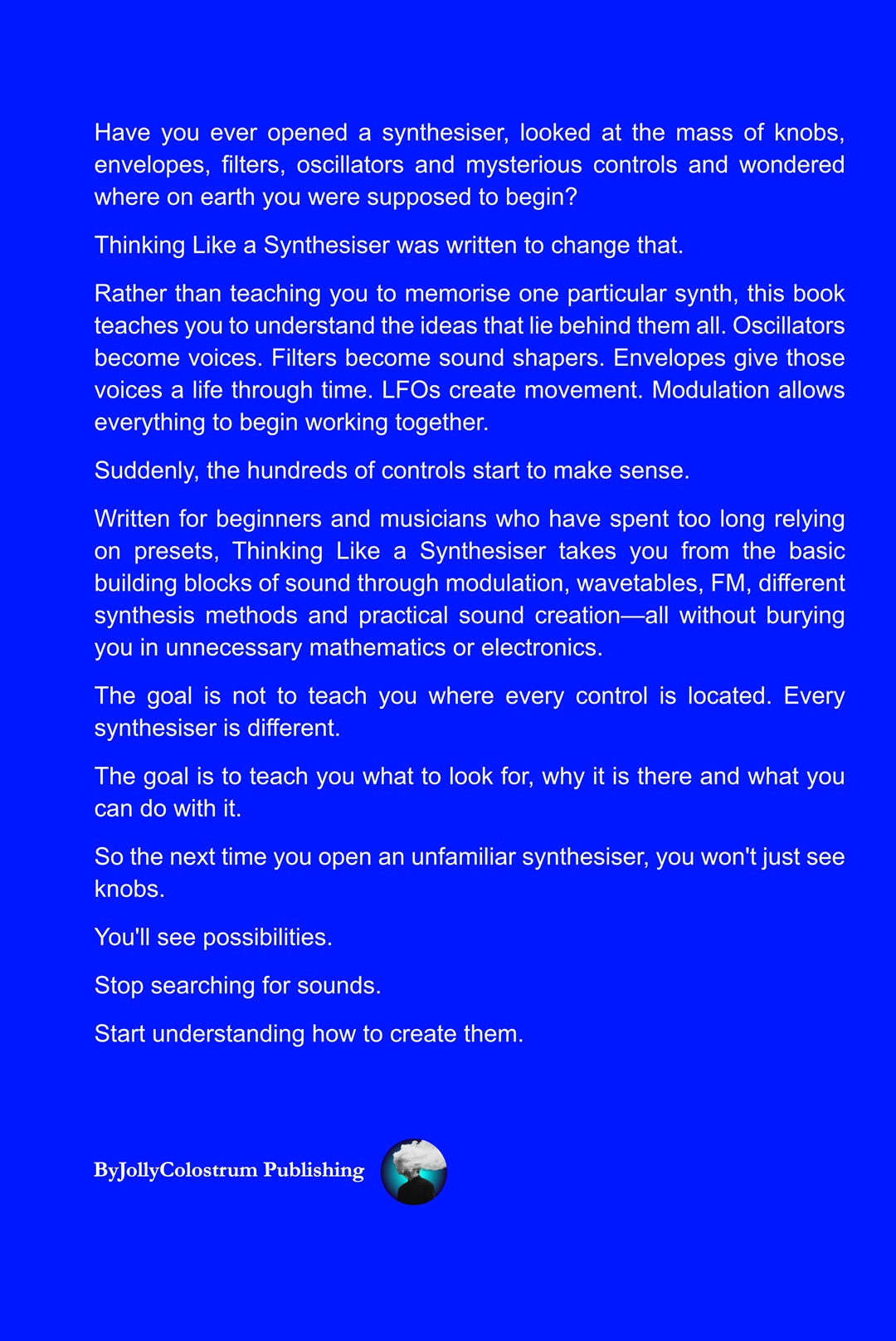
Thinking Like a Synthesiser is a beginner-friendly guide to understanding synthesis without drowning in electronics, mathematics or endless technical terminology. Rather than teaching you how to operate one particular instrument, it teaches you the ideas that lie behind them all.
At the heart of the book is a simple way of looking at synthesis.
The Oscillator Family creates the voice.
The Filter Family shapes that voice.
The Envelope Family gives it a life through time.
The LFO Family creates movement.
Once you understand what these families do—and how they work together—a synthesiser begins to look very different. What once appeared to be hundreds of unrelated controls starts to become a collection of familiar tools, each performing a recognisable job.
Beginning with the basic waveforms, Thinking Like a Synthesiser gradually explores filters, envelopes, LFOs, modulation, sources and destinations, pulse width, noise, wavetables, frequency modulation and other ways of creating and shaping sound. It also introduces different approaches to synthesis, including virtual analogue, hybrid, granular and physical modelling, before bringing those ideas together through practical sound-design examples.
But this is not a recipe book filled with settings to copy.
Different synthesisers put controls in different places, give them different names and sometimes approach the same task in completely different ways. This book isn’t designed to teach you where the filter is on every synth ever made. It teaches you what a filter is, why you might need one and what to look for when you want to change a sound.
That distinction is important.
Once you understand the principles, you can begin exploring instruments you’ve never used before. You can examine presets and understand why their designers made particular choices. You can take an existing preset that is almost right and know where to start changing it. And when you build a sound from scratch, you can make decisions with a purpose instead of randomly turning knobs and hoping something interesting happens.
Thinking Like a Synthesiser is written for beginners, musicians, composers and home producers who want to move beyond preset browsing and finally understand what is happening inside their instruments. The explanations are deliberately visual, practical and conversational, with complicated ideas broken into concepts that are easy to remember and apply.
You don’t need to memorise every synthesiser.
You don’t need to understand electronic circuitry.
And you certainly don’t need to know what every knob does before you begin.
You simply need to learn what to listen for, what to look for and which part of the synthesiser can do the job you need.
Stop looking at a synthesiser as a wall of mysterious controls.
Start looking at it as an instrument you understand.
Introduction
Welcome, Explorer
If you’re holding this book, there’s a good chance you’ve already been down the same road that I have.
You bought a synthesiser because you heard sounds that made you stop and listen.
Maybe it was the soaring lead in an electronic dance track. Maybe it was the haunting atmosphere in a science fiction film. Perhaps it was the deep cinematic rumble that made the hairs on the back of your neck stand up, or the warm analogue pad that seemed to wrap around an entire piece of music.
Whatever the sound was, it made you think,
“I wish I could make something like that.”
So, you opened your synthesiser.
And then…
Hundreds of knobs.
Sliders.
Buttons.
Menus.
Words like oscillator, filter, envelope, LFO, modulation, resonance and wavetable stared back at you.
You searched YouTube, watched tutorials and copied settings. Sometimes you even made a sound that you liked.
But there was always one frustrating feeling sitting quietly in the background.
“I still don’t really understand what’s going on.”
If that sounds familiar, you’re in exactly the right place.
This book isn’t about memorising controls. It isn’t about becoming a programmer. It isn’t about learning one particular synthesiser.
This book is about finally understanding why synthesis works, so the controls stop feeling like a wall of mystery and start becoming tools you can use on purpose.
We will start with the basic building blocks of sound, then follow the path a sound takes through a synthesiser: where it begins, how it is shaped, how it moves, and how it becomes expressive.
Because here’s the wonderful secret that took me far too long to discover. Synthesiser designers are not trying to confuse you. In fact, almost every synthesiser ever made is trying to solve exactly the same problem.
They simply solve it in different ways.
Once you understand those ideas, something remarkable begins to happen.
You stop seeing hundreds of controls. Instead, you begin recognising familiar friends. You look at an unfamiliar synthesiser and think,
“Ah… that’s where they’ve put the filters.”
or
“There’s the envelope.”
or
“I wonder how they’ve implemented modulation.”
The instrument changes.
Or rather…
Your way of seeing it changes.
That is what this book is really about. We’re going to explore synthesis together. But not as engineers or academics, but as curious people who love interesting sounds.
The controls may look different from one synthesiser to another, and manufacturers may use slightly different names, and they may hide things so you have to read the manual to find them, but the essential ideas remain the same. Learn to recognise the purpose behind the controls and you will be able to approach almost any synthesiser with confidence.
More importantly, we’ll listen. We’ll learn to hear sounds differently. We’ll stop asking,
“Which knob should I turn?”
and start asking,
“What am I hearing?”
That single change in thinking will make every synthesiser you ever use easier to understand.
There won’t be exams.
There won’t be homework.
There won’t be pages of technical jargon for the sake of sounding clever.
There will simply be questions.
Questions that gradually lead us towards answers.
Questions that encourage us to turn a knob, play a note and wonder,
“Why did that happen?”
Because curiosity is a far better teacher than memorisation.
By the time you finish this book, my hope isn’t that you’ll know every synthesiser ever made or every button, slider or drop down menu .
My hope is something much simpler.
I hope you’ll sit down in front of an instrument you’ve never seen before…
…smile…
…place your hands on the keyboard…
…and quietly say,
“Let’s see what sounds we’re going to discover today.”
Welcome.
Let’s begin.
Print length
307 pages
Language
English
Publication Date
17 August 2026
Dimensions
15.24 x 1.78 x 22.86 cm
ISBN-10
1764629086
ISBN-13
978-1764629089
PAPERBACK
Printed paperback edition
BUY NOW ON AMAZON →
Current price, availability and delivery costs are shown by Amazon and may vary by location.