
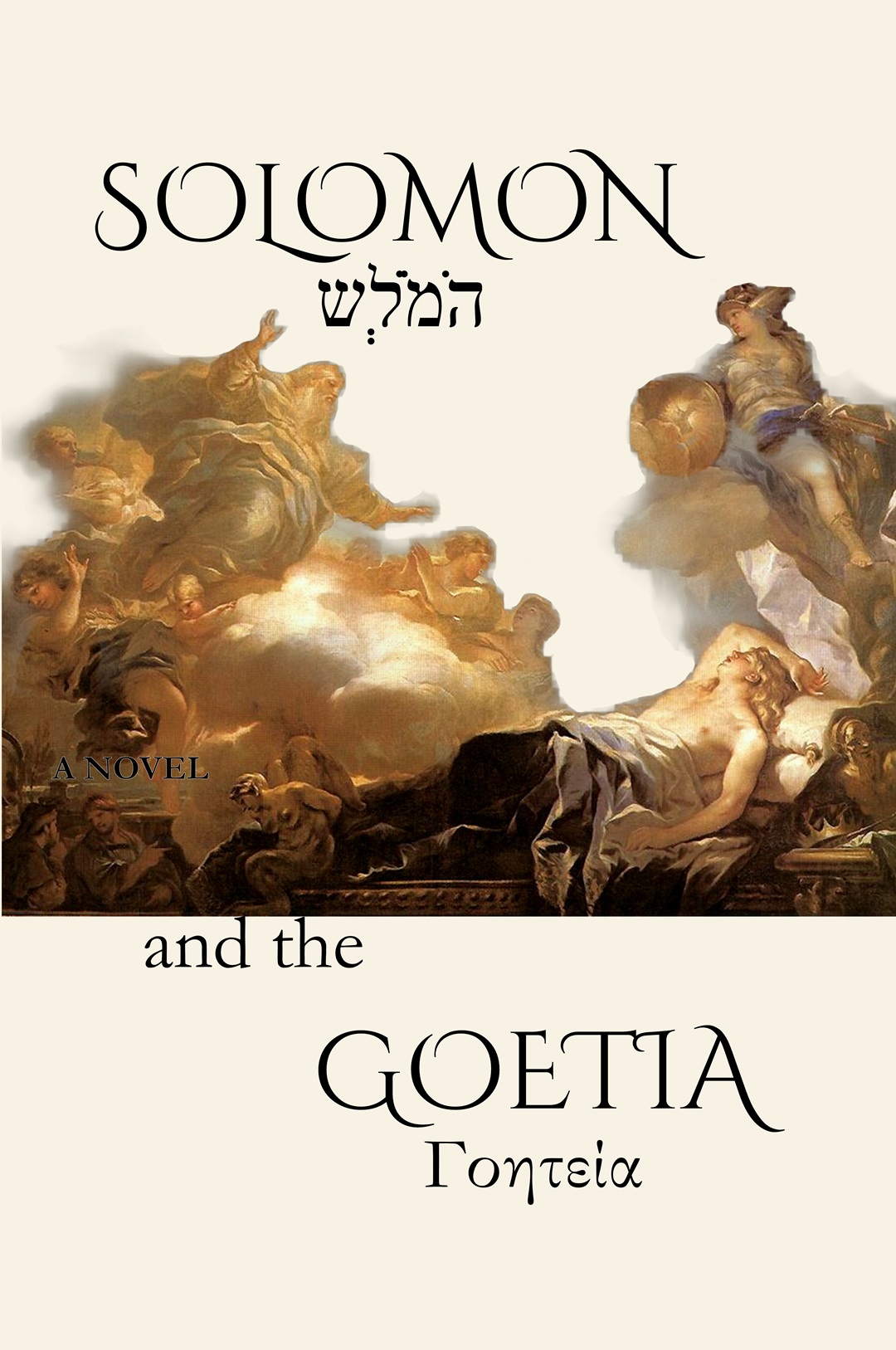
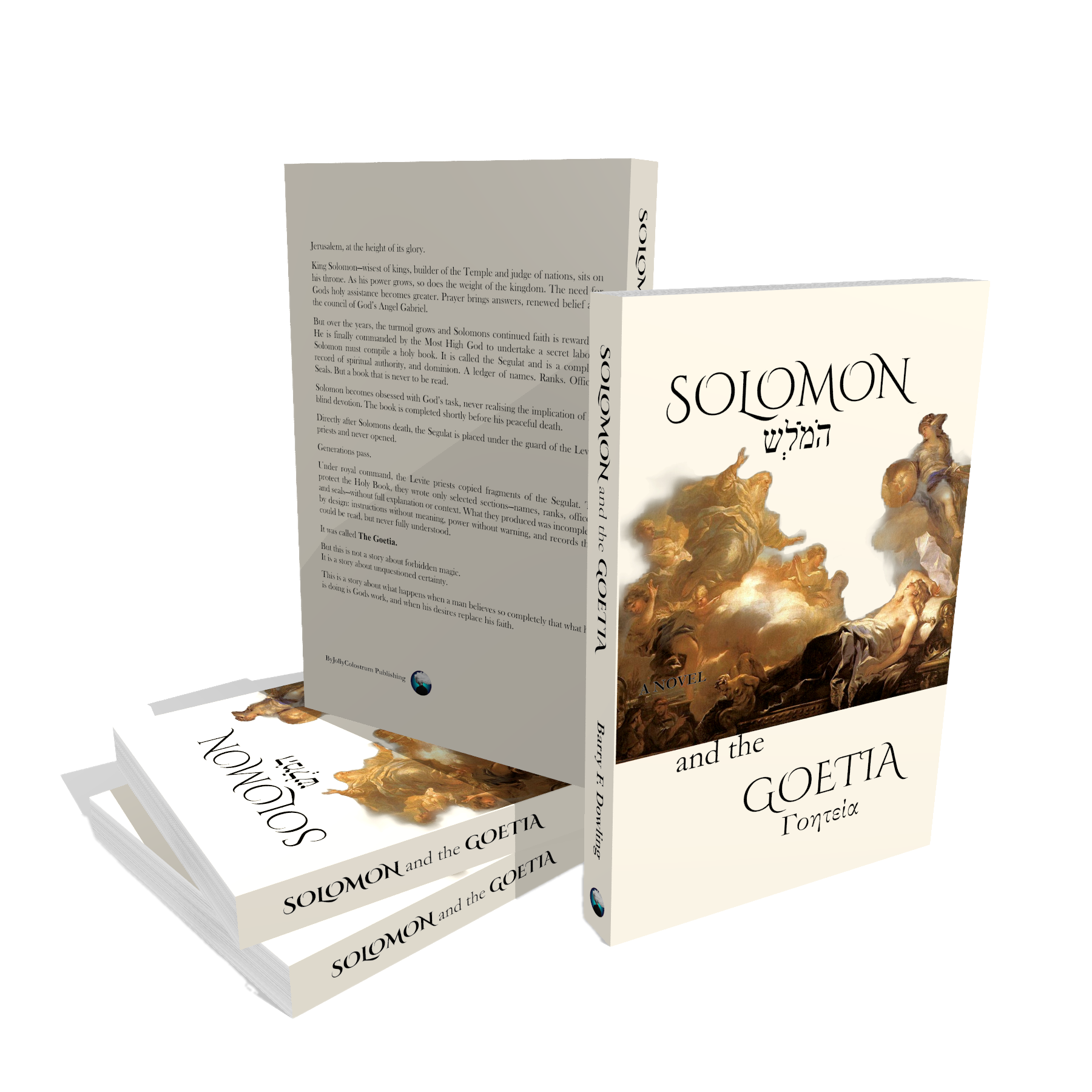
Solomon and the Goetia
By Barry F. Dowling (Author)
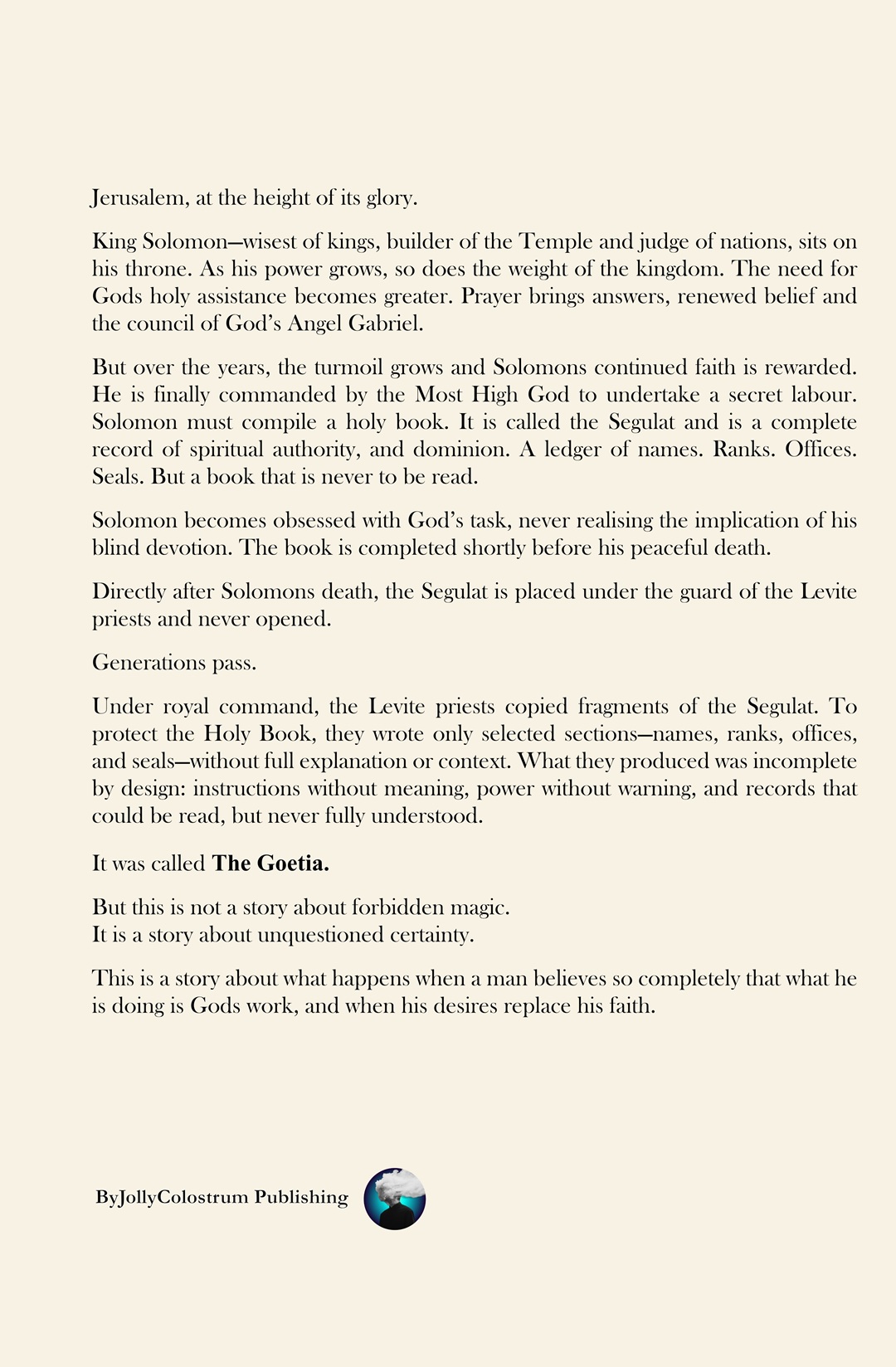
Jerusalem stands at the height of its glory.
And Solomon sits upon its throne.
King Solomon—wisest of kings, builder of the Temple, judge of nations—rules a kingdom unlike any the world has known. His wisdom is legendary. His devotion unquestioned. Yet as his power grows, so too does the burden of rule, and the weight of responsibility presses ever harder upon him.
Prayer brings answers.
Faith brings reassurance.
And divine counsel arrives through the angel Gabriel.
But divine certainty is never simple.
In the final years of his reign, Solomon is given a command unlike any before it: a secret labour, entrusted to him alone by the Most High God. Hidden beneath law, prayer, geometry, and ritual, he is ordered to compile a book never meant for human hands.
It is called the Segulat.
A complete ledger of spiritual authority and dominion.
A record of names. Ranks. Offices. Seals.
A book to be created… and never read.
As Solomon pursues this sacred task, devotion hardens into obsession. Angels advise. Demons obey. Order tightens around the king with terrifying precision. Yet faith that is never questioned becomes something else entirely, and obedience—once pure—begins to blur with desire.
The Segulat is completed shortly before Solomon’s peaceful death.
And then it is sealed away.
Guarded by the Levite priests, the book is never opened. Generations pass. Kingdoms rise and fall. Yet under royal command, fragments of the Segulat are copied—deliberately incomplete. Only selected elements are preserved: names, ranks, offices, seals. No explanations. No context. No warnings.
What remains is power without meaning.
Instruction without understanding.
Knowledge stripped of its source.
It comes to be known as the Goetia.
But this is not a story about forbidden magic.
It is a story about unquestioned certainty.
About obedience without reflection.
About what happens when a man believes so completely that he mistakes his own will for God’s.
Solomon and the Goetia is a richly detailed historical-theological novel that re-examines one of history’s most enigmatic figures, blending biblical tradition, ancient ritual, and philosophical tension into a haunting exploration of faith, authority, and consequence.
This is not a tale of rebellion against God.
It is the far more dangerous story of devotion taken too far.
Introduction
There are books that preserve life, and there are books that explain it. They sit openly on shelves and altars, carried by hands that expect to be guided. Their pages are turned in daylight. Their words are meant to be heard aloud. They instruct, console, warn, and remember. They tell men who they are, and who they ought to be, and what has already been decided on their behalf.
And then there are books that were never meant to be known at all.
Scripture speaks of a Book written by the hand of God, in which the names of the living are kept—those who walk in light, whose deeds are weighed, whose breath is borrowed and returned. It is spoken of with reverence and with fear. To be written within it is to belong. To be erased from it is to be undone. Its authority is not debated. Its judgement is final.
But scripture is silent about its shadow.
It does not speak of the record that runs beneath it, unseen and celebrated. It does not name the ledger that does not judge souls but assigns limits. It does not describe the register that does not preserve life, but restrains what must never be allowed to rise into it.
This book does not promise salvation.
It promises order. It was not written by angels, whose obedience is immediate and unburdened by doubt.
Nor was it revealed to prophets, who speak only what is placed upon their tongues.
It was not entrusted to priests, whose charge is to preserve what already exists.
It was not carried by kings as a symbol of divine favour.
It was written by a man.
His name was Solomon.
History remembers him clearly. He is remembered as the wisest king who ever lived, the builder of the Temple, the arbiter of justice whose judgements astonished nations. Scripture praises his discernment, his wealth, his devotion, and his songs. His reign is recalled as a golden age—an era unmarred by conquest, crowned by wisdom rather than blood, when the world came to Jerusalem not to threaten, but to listen.
What history does not remember is the cost of that wisdom.
For Solomon’s discernment did not end with judgement between men. It did not stop at proverbs or songs, or at the careful balancing of law and mercy. It did not remain content with knowing what was right. It expanded, slowly at first, as all certainties do.
When prayer was no longer sufficient, knowledge was sought.
When knowledge proved too vast for memory, it was recorded.
And when recording became necessary for survival, a system was built.
The book Solomon wrote was not a weapon. It was not an instrument of cruelty. It was not an act of rebellion.
It was an act of administration.
It named powers already present in the world. It ordered hierarchies already at work. It imposed boundaries where none had previously been enforced by human hand. It did not invent darkness; it catalogued it. It did not summon evil; it constrained what already pressed against the edges of creation.
Those bound within its pages were not enslaved. They were constrained. They were compelled, assigned, dismissed. They resisted. They negotiated. They endured.
And Solomon believed—utterly, faithfully—that it was God ordained.
The book was finished at the end of his life.
And it was hidden.
Not because it was evil.
Not because it was forbidden.
But because its existence collapsed choice itself.
For a world in which consequence can be commanded without repentance, where obedience becomes mechanical and judgement is reduced to procedure, is a world in which faith no longer has meaning. In such a world, humility is obsolete. Struggle becomes unnecessary. Silence ceases to instruct.
Such a book could not be public.
Not even in righteous hands.
After Solomon’s death, it passed quietly into priestly custody, sealed and untouched. It was treated as one treats something too heavy to discard and too dangerous to use. When the Temple fell, it went into hiding.
Centuries later, fragments were unearthed by those who no longer spoke the language in which it had been written. They preserved what they could. Names. Ranks. Offices. Seals. They assembled the remnants into something that could be studied, argued over, and copied.
They called the collection The Goetia.
They believed they had discovered a manual of demons.
They did not know they were reading the remains of a king’s holy task.
This is not the story of how evil entered the world. It was already here. This is the story of what happens when wisdom is trusted too completely, when certainty replaces humility, and when silence is mistaken for approval.
This is the story of Solomon.
Print length
384 pages
Language
English
Publication Date
9 January 2026
Dimensions
15.24 x 2.21 x 22.86 cm
ISBN-10
1764323122
ISBN-13
978-1764323123
PAPERBACK
Printed paperback edition
BUY NOW ON AMAZON →
HARDCOVER
Premium hardcover edition
BUY NOW ON AMAZON →
Current price, availability and delivery costs are shown by Amazon and may vary by location.