
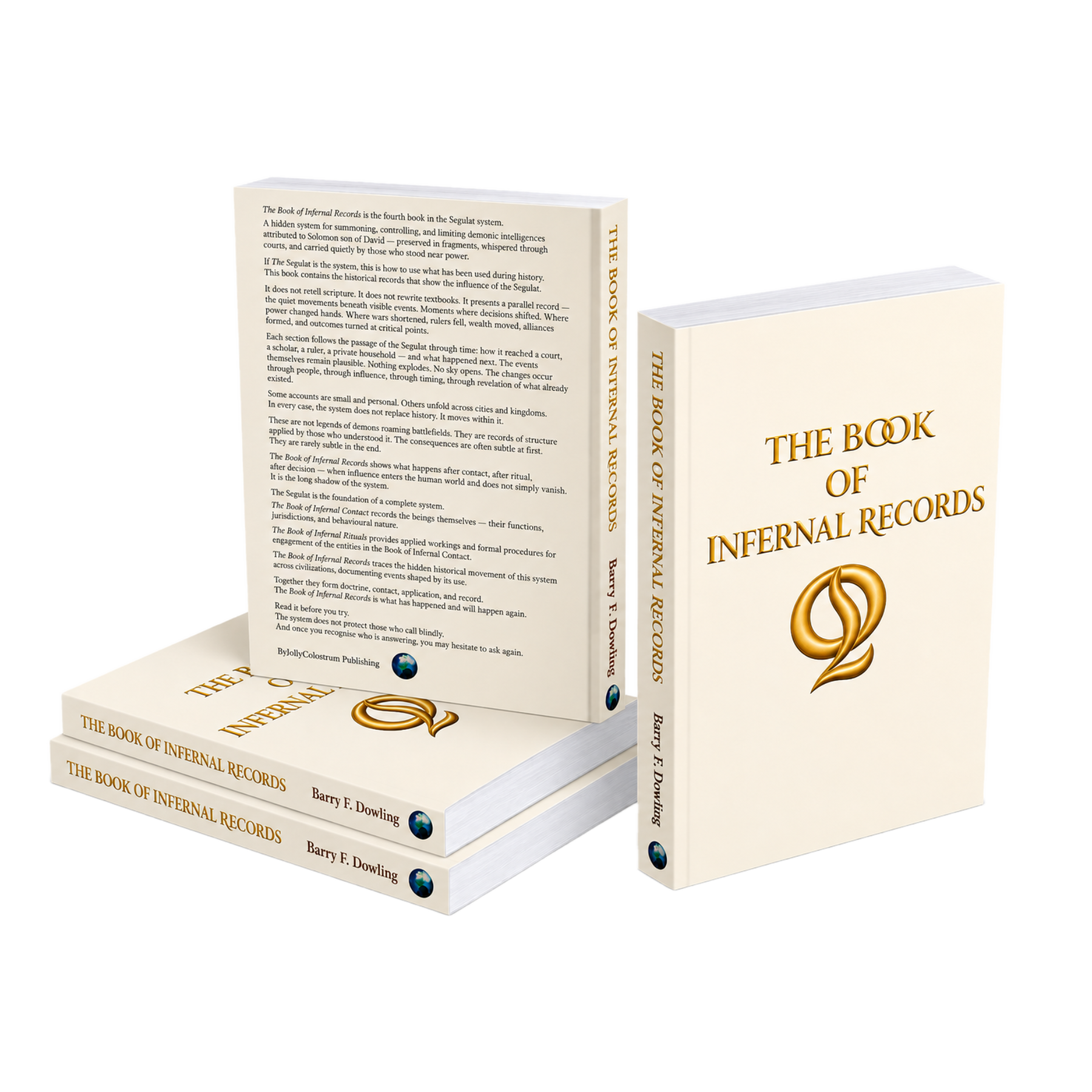
Book of Infernal Records
By Barry F. Dowling (Author)
For centuries there have been rumours of a Solomonic record that was never meant for public circulation. Not a devotional text. Not a book of pious prayers. Not a theatrical grimoire of fantasy monsters.
A working system.
A structured method for summoning, controlling, and using demonic intelligence’s attributed to Solomon son of David — preserved in fragments, whispered through courts, and carried quietly by those who stood near power.
The Segulat presents that system in clear, usable form.
This is not a recovered ancient manuscript. It is not a claim that you are holding the original book once sealed in Solomon’s chamber. It is a complete and organised presentation of the structure attributed to him — the doctrine, the rules, the uses, and the consequences.
If you have ever wondered how Solomon “commanded” spirits, this book answers that question in practical terms.
The Segulat does not promise miracles. It does not promise protection. It does not flatter the reader. It explains a rule: influence moves through limits.
The Book of Infernal Records is the fourth book in the Segulat series.
If The Segulat explains the structure, and The Book of Infernal Contact names the beings, and The Book of Infernal Rituals shows how to work with them, this book asks a harder question:
What happens when such a system is actually used?
The Book of Infernal Records presents a chronological account of events said to have been shaped by the Segulat across history. Courts. Wars. Trade routes. Religious movements. Political rises and sudden collapses. Quiet shifts in power that changed the direction of nations without public explanation.
These are not written as myths. They are not told as fantasy stories. Each account is presented as a record: where the system appeared, who handled it, what was asked, what changed, and what followed.
Some records describe rulers who secured their position through controlled influence.
Some show merchants who rose beyond expectation.
Some show movements that fractured after unseen intervention.
Some show personal ambition reshaping public history.
In every case, the pattern is the same. A defined request. A controlled engagement. A result. And a cost.
This book does not claim that every major event in history was caused by the Segulat. It does not claim that all power comes from hidden hands. It presents specific accounts and leaves the reader to consider them seriously.
For historians, it raises uncomfortable possibilities about influence and authority.
For those interested in biblical and Solomonic tradition, it gives context to the legend of a king who was said to command spirits and shape outcomes beyond normal means.
For practitioners, it provides something more important: perspective.
Before you attempt influence in your own life, it is wise to see how influence has unfolded before. The Book of Infernal Records shows that results are rarely simple. Gains carry weight. Victory reshapes the field. Control creates visibility.
If you are struggling to move forward in your own life, this book will not promise that history can be rewritten for you. It will show how decisions, once amplified by power, ripple far beyond their starting point.
Without The Segulat, these records are only strange stories.
Without The Book of Infernal Contact, you will not understand which functions were used.
Without The Book of Infernal Rituals, you cannot attempt anything yourself.
But with all four books together, you see the full system: doctrine, contact, application, and historical consequence.
This volume is not about how to call.
It is about what happens after the call is made — and how the world absorbs it.
Read it carefully.
Because once you see how power has been used before, you may think twice before reaching for it yourself.
Introduction
What These Records Are
This volume is a record.
It is not a book of instruction. It does not teach ritual. It does not explain how to summon, persuade, or command. Those matters belong elsewhere. This book preserves what was written after events took place.
The entries collected here document consultations, decisions, and outcomes. They record moments when the structure known as the Segulat was engaged in proximity to power. They note who stood near authority, what pressures existed at the time, and what followed. They do not claim control over history. They preserve the fact that consultation occurred.
The earliest entries refer to the reign of Solomon, son of David, during the period of the First Temple in Jerusalem. Later entries move through the exile in Babylon, the Persian administration, the Hellenistic courts, Roman governance, medieval advisory circles, and into more recent centuries. Some events are well known. Some are less discussed. All are anchored in real places and real eras.
These records were not written for public circulation. They were kept by a narrow line of keepers attached to legal, scholarly, and advisory roles. In some periods they were priests. In others they were scribes, translators, physicians, or counsellors to rulers. They did not present themselves as magicians. They preserved notes on consultation and restraint.
The Segulat was not treated as an object of worship. It was not displayed. It was carried. It moved through families and institutions that stood near decision-making. It was consulted rarely. When it was consulted, the engagement was recorded. Not to celebrate success, but to document consequence.
This book does not offer mythology. It does not attempt to retell history in dramatic form. It does not claim that wars were caused or empires directed. It records that at certain points before major decisions, structured consultation took place. It records that outcomes followed. It leaves the reader to observe the pattern.
Documentation exists because memory fails. Over generations, custodians learned that influence without record becomes story, and story becomes distortion. By writing, they restrained themselves. They marked what was done and what was not done. They noted cost alongside outcome.
The entries that follow are therefore archival in nature. They show proximity to power. They show disciplined engagement. They show restraint more often than action. In several cases they show refusal.
If these consultations were recorded, it was because those involved believed they mattered.
This volume preserves that fact.
What These Records Are Not
These records are not legend.
They are not tales shaped for entertainment. They do not exist to impress or to frighten. They do not describe visions, apparitions, or dramatic displays. Where consultation is noted, it is recorded in plain terms.
These records are not fantasy.
They do not present hidden kingdoms, secret orders ruling the world, or powers that move armies at command. They do not claim that rulers were controlled like pieces on a board. They do not rewrite history. The known facts of wars, treaties, successions, and collapses remain as they are recorded elsewhere.
These records are not a claim of ownership over history.
They do not say, “This caused the war,” or “This ended the empire.” They state only that a consultation is recorded prior to a decision. They show that structured engagement took place in proximity to authority. What followed is left alongside the public record.
These records are not political propaganda.
They do not defend a party, a nation, or a cause. They do not accuse living leaders. They do not assign blame. Where modern events are referenced, they are identified by era and circumstance, not by name. The purpose is documentation, not argument.
They are not devotional writing.
They do not ask for belief. They do not demand agreement. They preserve entries that were considered serious enough to write down and serious enough to restrict.
If they appear restrained, that is intentional.
If they appear incomplete, that is also intentional.
What is preserved here is limited to what was recorded: consultation, condition, outcome, and cost. Nothing more is claimed.
Series
Book 4 of 4
Print length
291 pages
Language
English
Publication Date
17 April 2026
Dimensions
21.01 x 2.18 x 29.69 cm
ISBN-10
1764629027
ISBN-13
978-1764629027
PAPERBACK
Printed paperback edition
BUY NOW ON AMAZON →
HARDCOVER
Premium hardcover edition
BUY NOW ON AMAZON →
Current price, availability and delivery costs are shown by Amazon and may vary by location.